


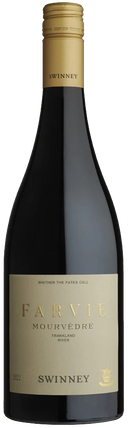
Swinney Farvie Mourvèdre Frankland River 2024
2024 Swinney Farvie Mourvèdre
Frankland River, Western Australia | 100% Mourvèdre | 13.6% alc | Allocation only
Of the three varieties that make up the Farvie lineup, Mourvèdre is the one that most people know least, and the one that this particular vineyard seems best suited to grow. It’s a variety that demands heat to ripen but produces its most interesting wines in sites where that heat is balanced by something else — cool nights, maritime influence, soils that stress the vine without starving it. Frankland River, for all that it’s categorised as a cool to moderate climate, gets enough warmth in late summer to push Mourvèdre to full physiological ripeness while the surrounding conditions preserve the freshness and structure that make the variety worth drinking.
The Farvie Mourvèdre draws from the Wilson’s Pool Vineyard, specifically from sections with leaner topsoil and a higher concentration of lateritic gravel — the same soil selection principle that governs the Farvie Grenache, but applied here to vines whose growth habits respond to that stress in a distinctly different way. The vines are dry-grown bush vines, managed with fruit thinning and selective hand harvesting over multiple passes to maximise the quality of what’s picked. The 2024 was harvested on the 11th of March — the latest of the three Farvie reds — which is consistent with Mourvèdre’s tendency to need extra hang time.
In the winery, the approach is uncompromising: 100% whole bunches, wild fermentation, gravity-fed to a single French oak vat. The wine spends 14 days on skins — longer than either the Syrah or Grenache — before being pressed directly to large-format seasoned French oak, where it ages for 11 months. No fining, minimal filtration. Residual sugar at 0.0g/L, fully dry. Alcohol at 13.6% — the lowest of the three Farvie reds. Bottled 25th February 2025. The winery spec has pH sitting at 3.64 with acid at 5.28g/L, giving this a softer acid profile than the Grenache but still structured.
The colour is a deep maroon, richer and denser than the Grenache. Held to the light it shows a dark ruby core with a slightly garnet edge. The legs move slowly. From the moment the glass is poured, there’s an interesting duality on the nose: something dark and brooding underneath, and something fresher and more aromatic on top. The aromatics on first approach are focused and specific — satsuma plums, wild raspberries, Chinese five-spice, and a distinct thread of nori or seaweed that appears here just as it does in the Farvie Syrah. It’s an unusual combination but it hangs together convincingly. There’s nothing muddled about it.
Given time — and this wine rewards patience in the glass more than the other two — earthy, gamey notes start to emerge. Charcuterie, smoked meat, something faintly animal. These are textbook Mourvèdre signatures, but expressed with far more restraint and refinement than you’d find in a warmer-climate version of the variety. As the wine breathes further, the floral dimension starts to reveal itself: violets, just a trace of fresh tobacco, and something that edges toward dried herbs. On the second day from an open bottle, the winery notes that these florals become even more profound. That checks out — this is a wine that changes meaningfully with air.
On the palate, the entry is medium-bodied and precise. There’s an immediate quality of structure and grip — the tannins are firm and present from the first moment, fine-grained rather than coarse, but clearly built to last. The fruit expression is dark: cassis, blackberries, plum — and alongside it an ironstone minerality that’s the most pronounced of any of the three Farvie reds. It’s that particular ferrous, almost blood-like quality that seems to come directly from the vineyard’s lateritic gravel composition. The salted licorice and pomegranate molasses notes in the winery’s own tasting notes are accurate — there’s a sweetness to the fruit but it’s tempered immediately by that savouriness and mineral grip.
Mid-palate, the wine opens into something more complex and layered. White pepper shows, the florals from the nose translate into something barely there but present, and the whole-bunch inclusion contributes a cool herbal spiciness that keeps the palate from settling into heaviness. The texture is fleshy but taut — there’s density here without weight. It’s a difficult balance and the winery has managed it well. The acidity, while softer than the Grenache, is still present enough to provide lift and ensure freshness. Nothing here feels flat or dull.
The finish is the longest of the three Farvie reds, and arguably the most serious. The gravelly mineral texture persists well after the fruit has faded. Dried herbs and a whisper of dark chocolate round things out in the final seconds. The tannins firm at the very end without drying. What’s left on the palate after the finish is a quiet, persistent impression of earth and iron that takes its time to dissipate. This is a wine being described in critical circles as one of the best expressions of the variety anywhere in the world, and while that’s a bold claim, there’s nothing in the 2024 that makes it feel like an overstatement.
The Farvie Mourvèdre is built for the long term. The winery rates it at 10-plus years; experienced palates who have tasted across multiple vintages are suggesting 15 to 25. At two years old it is already compelling, but it is clearly in the early stages of what it will eventually become.
96 | Harvested: 11th March 2024 | Bottled: 25th February 2025 | pH 3.64 | TA 5.28 | RS 0.0g/L | 13.6% alc
Featured Products
View All

Related Posts
View All
Swinney Grenache Frankland River 2024

Swinney Syrah Frankland River 2024
winetrust.com Comment Policy
Please read our Comment Policy before commenting.